TOMBSTONE ARIZONA HISTORY: See the past
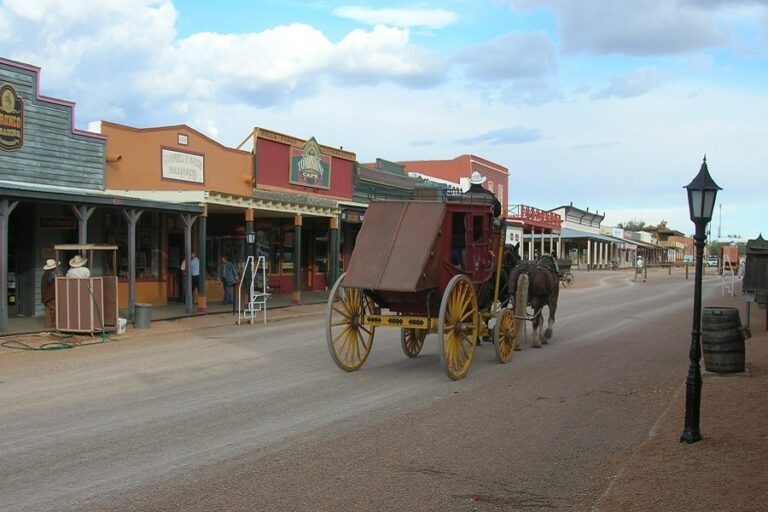
When you visit to Tucson Arizona, your experience will never be complete without seeing Tombstone Arizona, just to the east of town. It’s the site of the infamous OK Corral. Made even more famous by the movie Tombstone, this small historic town is an exciting family destination. Tombstone Arizona history will truly intrigue you.
To begin, Tombstone Arizona is a historic city in Cochise County, founded in 1877 by prospector Ed Schieffelin. Originally located in the Arizona Territory, it became one of the last boomtowns in the American western frontier. It grew significantly during the mid-1880s as the local mines produced $40 to $85 million in silver bullion.
In Tombstone Arizona history, this town was the largest productive silver district within Arizona. As such, its population grew from 100 people to around 14,000 in less than seven years. Now, continue reading to learn more about Tombstone Arizona history.
Tombstone Arizona almost was a ghost town
In Tombstone Arizona history, it nearly became a ghost town, saved only because it was the Cochise County seat until 1929. The city’s population dwindled to a low of 646 in 1910, but grew to 1,380 by 2010. This town was frequently noted on lists of unusual place names.
Tombstone Arizona history is famous
Established on Goose Flats, Tombstone is a mesa above the Goodenough Mine. Within two years of its founding, although far distant from any other metropolitan area, Tombstone Arizona had a bowling alley, four churches, an ice house, a school, two banks, three newspapers, and an ice cream parlor, alongside 110 saloons, 14 gambling halls, and numerous dance halls and brothels.
All of the businesses in Tombstone were situated among the many silver mines there. The gentlemen and ladies of Tombstone attended operas presented by visiting acting troupes at the Schieffelin Hall opera house, while the miners and cowboys saw shows at the Bird Cage Theatre and brothel.
The Earp brothers lived in Tombstone
In the mid-1880s, the silver mines penetrated the water table and the mining companies made significant investments in specialized pumps. A fire in 1886 destroyed the Grand Central hoist and the pumping plant. As such, it was deemed unprofitable to rebuild the costly pumps.
The Earp brothers—Wyatt, Virgil and Morgan—as well as Doc Holliday, arrived in December 1879 and mid-1880. The Earps had ongoing conflicts with Cowboys Ike and Billy Clanton, Frank and Tom McLaury, and Billy Claiborne. The Cowboys repeatedly threatened the Earps over many months until the conflict escalated into a shootout on October 26, 1881. The historic gunfight is often portrayed as occurring at the O.K. Corral, though it actually occurred a short distance away in an empty lot on Fremont Street.
Deadly conflict was cased by these tensions
The booming city was only 30 miles (48 km) from the U.S.–Mexico border. Back then, it was an open market for cattle. Of course, the cattle was stolen from ranches down in Sonora, Mexico. And the thieves were loosely-organized outlaws called The Cowboys.
Under the surface were tensions that grew into deadly conflict. The mining capitalists and the townspeople were largely Republicans from the Northern states. Many of the ranchers (some of whom—like the Clantons—were also rustlers or other criminal varieties) were Confederate sympathizers and Democrats.